
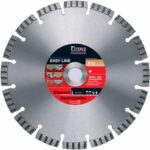
Professional diamond blades are designed for demanding cutting jobs involving materials such as concrete, brick, block and masonry.
Choosing the right blade can improve cutting speed, reduce glazing and help you get more from your cutting equipment. However, different materials place different demands on a diamond blade.
For example, reinforced concrete, dense engineering brick and abrasive materials can require a different blade specification from standard masonry.
In this guide, we’ll explain how diamond blades work, the main blade types and the factors to consider when choosing a blade for your machine and material.
If you already know what you need, browse our concrete cutting blades or continue reading for practical guidance.
Diamond blades are steel-core cutting discs with industrial diamonds bonded into the cutting edge.
As the blade rotates, the exposed diamonds grind through the material. As the cutting edge wears, fresh diamond particles become exposed.
The bond is particularly important because it controls how quickly the diamonds are released.
A correctly specified blade therefore needs the right balance of:
As a result, the same blade will not necessarily perform equally well on every material.
The correct diamond blade can be used for a wide range of construction materials.
Common applications include:
However, material type matters.
A blade that performs well when cutting standard concrete may not be the best choice for dense engineering brick or porcelain.
For that reason, always match the blade to the material and the machine.
Segmented diamond blades have separate cutting segments with gaps between them.
They are widely used for construction cutting because the gaps allow air to circulate around the cutting edge.
Segmented blades are commonly used for:
They are particularly useful when cutting performance and material removal are more important than achieving an ultra-smooth edge.
Turbo diamond blades have a closely spaced cutting edge with a textured or serrated appearance.
They provide a balance between cutting speed and finish.
Turbo blades can be useful for applications where you want controlled cutting without the more aggressive appearance of a conventional segmented blade.
The correct choice still depends on the material, machine and required finish.
Continuous-rim diamond blades have a continuous cutting edge rather than separate segments.
They are commonly associated with applications where a cleaner, more controlled cut is required.
They are particularly common for materials such as porcelain and ceramic tiles.
For tile applications, see our Tile, Porcelain and Ceramic Cutting Guide.
Choosing professional diamond blades starts with identifying the material you need to cut.
Consider these five factors before selecting a blade:
Different materials create different cutting conditions.
Standard concrete, reinforced concrete, engineering brick, block and natural stone can all behave differently during cutting.
Dense materials can create greater resistance and heat. Abrasive materials can wear a blade more quickly.
Therefore, choose a blade that is designed for the material rather than simply selecting the cheapest available option.
For more detailed guidance, see our How to Choose the Right Diamond Blade.
Reinforced concrete contains steel reinforcement as well as aggregate and cement.
When the blade encounters steel, cutting becomes more demanding. Heat and resistance can increase, so the blade needs to cope with intermittent contact with reinforcement.
For more information, see our guide to cutting reinforced concrete.
The machine affects the blade size, cutting depth and operating speed you can use.
Depending on the job, you may be working with:
Always check the blade diameter, bore size and maximum RPM before fitting a blade.
The blade must be suitable for the machine.
For a comparison of two common options, read our Angle Grinder vs Petrol Saw for Concrete Cutting.
Required cutting depth also affects blade and machine selection.
A small angle grinder may be suitable for shallow cuts, while deeper structural cuts can require a larger machine and blade.
Our Concrete Cutting Depth Guide explains how blade diameter and machine type affect practical cutting depth.
The required finish can influence blade selection.
For example, a segmented blade can be a good choice when fast material removal is the priority. A continuous-rim blade may be more appropriate when a cleaner edge is required on suitable materials.
Therefore, consider both cutting performance and finish quality when choosing your blade.
Concrete is one of the most common applications for professional diamond blades.
However, concrete is not always the same.
Standard concrete, high-density concrete and reinforced concrete can place different demands on the blade.
If you regularly cut concrete, reinforced concrete or dense construction materials, choose a blade designed for the application.
Our concrete cutting blades are selected for professional cutting applications.
For a broader explanation of the cutting process, see our Concrete Cutting Guide.
Diamond blades can be used for cutting brick and block, but the material still needs to be considered carefully.
Standard brick and block can often be cut using a suitable construction blade.
However, engineering brick is considerably denser than many standard bricks. This can increase resistance and may cause an unsuitable blade to glaze.
If you regularly cut engineering brick, see our guide to Cutting Engineering Brick Properly.
A diamond blade can glaze when the cutting edge stops exposing fresh diamond particles effectively.
The blade may then appear to polish the material rather than cut efficiently.
Incorrect blade specification, material density and cutting conditions can all affect performance.
If your blade has become slow or appears to be polishing rather than cutting, read our guide to Why Diamond Blades Glaze and How to Fix It.
The cheapest blade is not necessarily the most economical option.
A poorly matched blade can:
In contrast, correctly specified professional diamond blades can provide more consistent cutting performance for demanding site work.
The important point is not simply buying a more expensive blade. It is choosing a blade that matches the material, machine and application.
Even the right blade can perform poorly if it is used incorrectly.
Before cutting:
If a blade suddenly stops cutting properly, don’t assume it is simply worn out.
The problem could be the wrong blade specification, incorrect cutting technique, excessive heat or glazing.
Not sure which blade you need?
Before choosing a blade, tell us:
We can then help you narrow down the options.
If you prefer to speak to someone, call Chris on 07879 653725
We supply diamond blades for a range of professional cutting applications.
Our range includes blades for:
Browse our diamond blades for professional cutting applications to find the right blade for your job.
If you already know the material and machine you are using, you can also browse our concrete cutting blades.
Professional diamond blades are used for cutting hard construction materials such as concrete, reinforced concrete, brick, block and masonry. The correct blade depends on the material, machine and cutting requirements.
The right diamond blade depends on the type of concrete, whether it contains reinforcement, the required cutting depth and the machine being used. A blade designed specifically for concrete cutting is generally preferable to an unsuitable general-purpose blade.
Yes. Suitable diamond blades can cut brick and block. However, dense materials such as engineering brick may require a blade designed for the additional resistance and cutting conditions.
Segmented blades have separate cutting segments and are commonly used for aggressive construction cutting. Turbo blades have a closely spaced textured cutting edge and can provide a balance between cutting speed and finish.
Some blades can cut more than one type of construction material. However, a blade designed specifically for the material and application can provide better performance. Always check the manufacturer’s specifications before using a blade on a different material.
A diamond blade can lose cutting performance because of glazing, incorrect blade specification, excessive heat or unsuitable cutting technique. Check that the blade matches the material and machine before replacing it.
The right blade should match the material, machine and job.
Don’t choose a blade simply because it is the cheapest option. Instead, choose a specification that suits the work you actually need to do.
Right blade. Right machine. Better cutting.
See our products in action on our TikTok, YouTube and Instagram channels for more site-ready gear and updates